Kosovo Food: A Guide to Kosovar Cuisine
Kosovo food explained: flia baked under embers, pies and burek, tavë, Sharr and Rugova cheese, ajvar, macchiato and tea culture, and wine from Rahovec.
Published
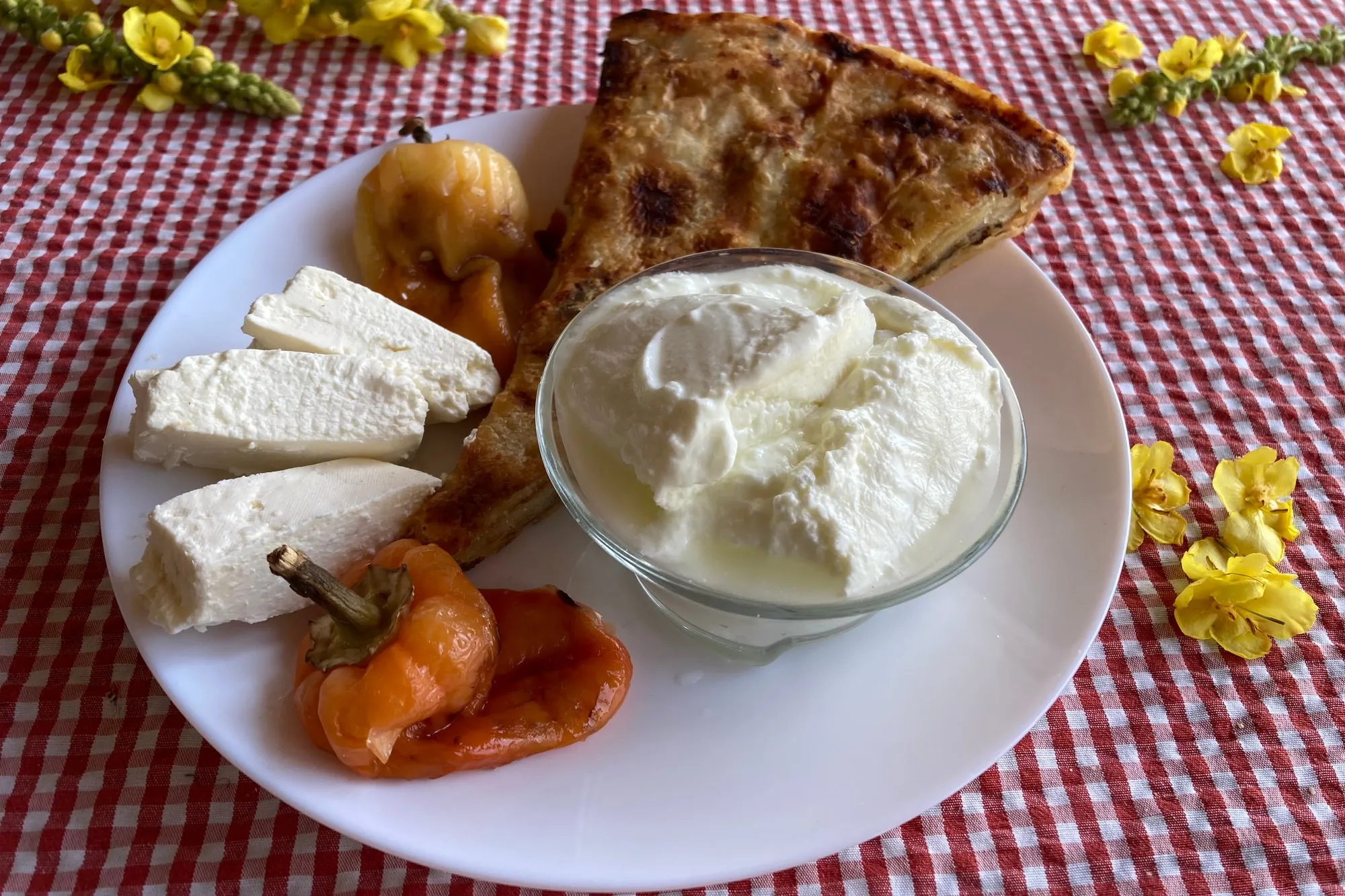
Kosovo food is mostly Albanian home cooking with strong Ottoman and Balkan influences: slow-baked flia, pies and burek, casseroles called tavë, grilled meat, white cheeses from the mountains, peppers turned into ajvar in autumn, and a café culture built on macchiato and tea. Wikipedia describes Kosovar cuisine as largely an expression of Albanian cuisine with Balkan elements. Many dishes are shared with Albania, North Macedonia, Serbia, Bosnia and Turkey, and this guide says so where the sources do.
Below: the dishes to know, the regional specialities, drinks, customs and how to cook some of them at home.
Flia: the signature dish
Flia (also fli or flija) is the dish most closely tied to Kosovo. Thin, crêpe-like layers of batter are spread one at a time in a wide round tray, each brushed with cream, and baked under a saç, an iron lid covered with hot embers, so that the heat comes from above. Slow Food, which lists the flia of the Rugova valley in its Ark of Taste, says the “secret” is kaymak, a thick cream. It is served with cheese, jam (reçel), honey, yogurt, suxhuk sausage and pickles.
It takes time, and the sources do not agree on how much: two to three hours for Slow Food, four to five for a report in Prishtina Insight. Slow Food considers flia at risk because the mountain villages are emptying, although Prishtina Insight found family kitchens in the capital delivering several flia and pies a day.
Flia is shared with northern Albania, and Slow Food notes that around Ohrid and Prespa in North Macedonia it is called gjomleze. Our flija recipe adapts it for a home oven.
Pies, burek and bread
After flia comes the wider family of pies. Bradt describes burek with meat, white cheese or spinach as the usual breakfast or mid-morning snack, often eaten with ajran, a salted yogurt drink, and pite with fillings of meat, pumpkin, cabbage or nettles. For the difference between the names, see our guide to byrek, burek and börek.
In Prizren, the month of Ramadan has its own bread: round pitarke baked in wood-fired ovens. RFE/RL reported in 2022 on a Prizren family bakery that has made them for more than a century, and for whom they are essential at the evening meal that breaks the fast.
Tavë and other main dishes
| Dish | What it is | Notes from the sources |
|---|---|---|
| Tavë kosi, tavë Elbasani | Lamb baked under yogurt and eggs | Also found in Albania, North Macedonia, Greece and Turkey |
| Tavë Prizreni | Lamb and vegetable casserole | Named after Prizren |
| Qebapa | Small grilled sausages of minced lamb and beef, with onion, sour cream, ajvar and flatbread | Bradt also mentions pljeskavica, a grilled patty |
| Pasul | White bean soup with beef and paprika | |
| Sarma | Minced meat rolled in cabbage or vine leaves | |
| Mantia | Small baked dumplings with yogurt poured on top | Wikipedia links it to the Sandžak region as well |
| Suxhuk | Dry, spicy, fermented sausage | Served with flia, per Slow Food |
Tavë kosi is thought to come from Elbasan in Albania and is known across the region; our guide to the Albanian national dish tells its story, and our tavë kosi recipe gives exact quantities. Wikipedia is our only source for several dishes in the table, and its article on Kosovar cuisine is flagged as needing more citations, so treat the details as a starting point.
Cheese from the mountains
Kosovo’s two best-documented cheeses come from its mountains:
- Sharr cheese (djathë i Sharrit, Šar), from the Sharr mountains in the south around Dragash, is described in a 2021 scientific paper as a seasonal pastoral sheep’s cheese. RFE/RL reported in 2020 that it is often made from unpasteurised sheep’s milk, sometimes cow’s, that its flavour comes from mountain herbs at around 1,800 metres, and that some companies now make it on an industrial scale. Bradt describes it as soft and feta-like. Researchers followed its path towards a geographical indication from 2015 to 2019; we could not confirm whether it has one today.
- Rugova cheese, from the mountains above Peja (Peć), is made from raw cow’s, sheep’s or goat’s milk. A 2022 study compared the traditional and industrial versions.
Peppers and ajvar
Ajvar is made by roasting red peppers over a wood fire, peeling them and cooking them slowly with oil, sugar and vinegar. Euronews described its production in 2020 in Krusha e Madhe, and noted that several Balkan countries claim ajvar and its origin is unclear. Bradt adds that many families make their own. Ajvar goes with grilled meat and bread; pickled vegetables, turshi, are the other winter preserve.
The Gorani of the south
In the Gora area around Dragash, the Gorani community has its own food traditions. Slow Food lists three Gorani products in its Ark of Taste: a halva made with the root of a wild plant (Chenopodium bonus-henricus) for St George’s Day on 6 May, boza made from millet, and a fermented drink called sok. A 2017 study by the ethnobotanist Andrea Pieroni and colleagues recorded their uses of wild plants and found that some practices were adapted from Serbian and Bosniak neighbours.
Sweets
Bradt writes that Kosovo is not known for its desserts, but the familiar Ottoman-era sweets are everywhere: bakllava, especially at the end of Ramadan, and, as Wikipedia also lists, tulumba, fried dough in syrup. Trileçe, the milk-soaked cake, is popular across Kosovo and Albania, and its origin is still debated. Try our baklava and trileçe, and read more in our guide to Albanian desserts.
Coffee, tea, boza and rakia
Coffee. The macchiato is the symbol of Prishtina’s cafés. AFP reported in 2025 that the boom in Western-style cafés is linked to the years after 1999 and to the international presence, while Turkish coffee has been drunk for centuries. Bradt notes that in villages you may still be asked how sweet you want your Turkish coffee. You will read that Prishtina makes the best macchiato in the world; that is the opinion of café owners, not a measurable fact.
Tea. According to Bradt, people in Kosovo drink more tea at home than in Albania or Serbia, especially around Prizren. The town of Vushtrri is known as the capital of tea: AFP describes two stacked kettles, tulip-shaped glasses, roughly one tea house per 1,000 inhabitants and an annual festival.
Boza. In Kosovo boza is made from maize and wheat and drunk as a summer refreshment; in Gjakova it is mixed with lemonade as a shpricer.
Rakia. Distilled by all communities, from grapes, pears, plums or quince. In the Drini valley, Prishtina Insight found plum rakia aged in mulberry barrels and was told that every family keeps a reserve. Our guide to Albanian drinks covers raki and boza in more detail.
Wine and beer
Kosovo has about 3,400 hectares of vineyards, according to the ministry of industry, of which about 2,465 are around Rahovec (Orahovac), with smaller areas around Suhareka, Prizren and Gjakova. There are 35 licensed wineries, and three of them make about 70% of the wine. The largest, Stone Castle, was described by PRI in 2013 as holding about five million litres. Rahovec celebrates the harvest with Hardh Fest in September, which reached its tenth edition in 2024.
For beer, Birra Peja is the largest brewery and, according to Bradt, the most popular beer. Since 2012 craft breweries have appeared, starting with Sabaja.
Hospitality
Bradt writes that families are proud to host and will invite visitors home for a tavë and rakia, and that coffee, sweets or rakia are the usual offer to a guest. Kosovo also produces a chestnut honey in the Deçan and Junik area, listed by Slow Food.
Cooking Kosovo food at home
- Flija, for a slow weekend.
- Tavë kosi, the shared casserole.
- Spinach byrek, close to the burek Bradt describes.
- Baklava and trileçe for dessert.
For the Albanian side of the table, start with our guide to Albanian food and our guide to the Albanian breakfast.
Frequently asked questions
What is the national dish of Kosovo?
There is no official one, but flia (also called fli or flija) is the dish most associated with Kosovo: thin layers of batter brushed with cream and baked for hours under a lid covered with embers. Slow Food lists the flia of the Rugova valley in its Ark of Taste.
Is Kosovo food the same as Albanian food?
Largely, since most people in Kosovo are Albanian, and dishes like flia, tavë kosi and trileçe are shared. Kosovo also has strong Ottoman and Balkan influences, specialities of its mountain areas such as Sharr and Rugova cheese, and, according to Bradt, a stronger tea culture at home.
What do people in Kosovo eat for breakfast?
Sources differ. Wikipedia describes a light breakfast of coffee with a croissant, eggs or toast, while Bradt names burek with meat, cheese or spinach, often with ayran, as the usual breakfast or mid-morning snack.
What is ajvar?
A relish of red peppers roasted over a wood fire, peeled and slowly cooked with oil, sugar and vinegar, made in autumn in villages such as Krusha e Madhe. Several Balkan countries claim it and its origin is unclear.
Does Kosovo make wine?
Yes. The ministry of industry counts about 3,400 hectares of vineyards, most of them around Rahovec (Orahovac), and 35 licensed wineries. Rahovec holds a grape festival, Hardh Fest, in September.
Sources
- Flia, Ark of Taste, Slow Food Foundation for Biodiversity
- Ark of Taste: Kosovo, Slow Food Foundation for Biodiversity
- Gorini halva, Ark of Taste, Slow Food Foundation for Biodiversity
- Gorani Boza, Ark of Taste, Slow Food Foundation for Biodiversity
- Chestnut Honey, Ark of Taste, Slow Food Foundation for Biodiversity
- Kosovo Travel Information and Guide, Bradt Guides
- Pritë Bytyçi, In a Fast-Changing Kosovo, Slow Food Keeps its Place, Prishtina Insight (2022)
- Nate Tabak, Finding soul food in western Kosovo, Prishtina Insight (2016)
- Faith Bailey, Beyond the pils: Kosovo's expanding beer scene, Prishtina Insight (2017)
- Kosovo's Jubilar Grape Festival, Prishtina Insight (2024)
- Pungent Pastures: Making Kosovo's Traditional Sharr Cheese, RFE/RL (2020)
- Bernard-Mongin et al., GI Building Process for Sharr Cheese, Sustainability 13/10 (2021)
- Sulejmani and Selimi, Technology and composition of traditional and industrial Rugova cheese, Journal of Central European Agriculture 23/4 (2022)
- Pieroni et al., Traditional food uses of wild plants among the Gorani of South Kosovo, Appetite 108 (2017)
- Pepper season in the Balkans means it's ajvar sauce production time, Euronews (2020)
- Brewing battle: coffee booms in tea-loving Kosovo, AFP via Arab News (2025)
- Ramadan pitas in Prizren, RFE/RL (2022, in Serbian)
- Vineyards and Wines Sector, Ministry of Industry, Entrepreneurship and Trade of Kosovo
- Kosovo wants to be the next Napa, PRI The World (2013)
- Kosovar cuisine, Wikipedia
- Tavë kosi, Wikipedia