Byrek vs Burek vs Börek: What Is the Difference?
Byrek vs burek vs börek: how the Albanian, Balkan and Turkish pies differ in dough, fillings, shape and name, with a comparison table and their shared history.
Published
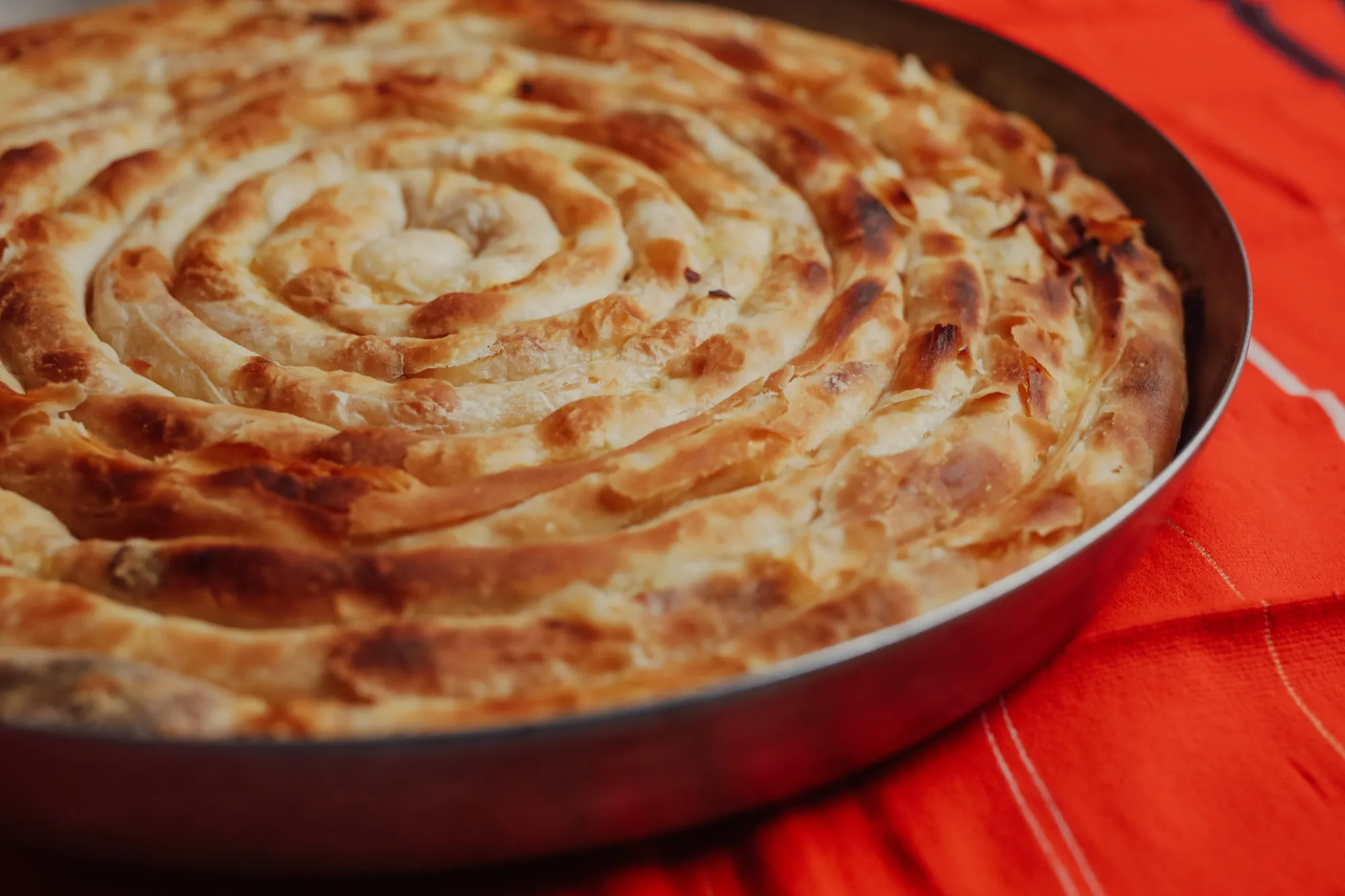
Byrek, burek and börek are the same family of filled pastry and the same word in three languages. Börek is the Turkish original and covers dozens of pastries, from fried cheese rolls to layered tray pies. Burek is the Balkan form: in Bosnia it means only the meat-filled pie, while in Serbia, North Macedonia and Slovenia it is a round tray pie with any filling, bought from a bakery for breakfast. Byrek is the Albanian name for a pie of thin hand-rolled sheets baked in a round tray and filled with cheese, spinach, meat and much more. The differences lie in the dough, the shape and what each country calls what.
One word, three languages
All three names come from the Turkish börek. Linguists agree on that much but not on what the word originally meant. The most common explanation derives it from a Turkic root meaning “to twist” or “to wrap”. The Turkish etymological dictionary Nişanyan suggests, with caution, a medieval word for “little kidney” or “small bundle”, and considers the Persian būrak a loan from Turkish rather than the source. The oldest written record it cites dates from 1312 and already describes dough pieces stuffed with meat, a skewered version and a sweet one. An Ottoman law code of 1502 mentions the trade of börekçi, börek makers.
Where the pastry comes from
The origins are poorly documented and two theories compete:
- Central Asia. The food historian Charles Perry argued that the nomadic Turks had a special love of layered and folded breads. An 11th-century dictionary by Mahmud al-Kashgari records a “pleated or folded” bread, and the Oxford Companion to Food notes that börek was originally cooked on the saj, the iron sheet of the nomads. In this view the pastry travelled west with the Turkic migrations and the Seljuks into Anatolia.
- Byzantium and Rome. Other scholars, among them the historian Speros Vryonis, see börek as a descendant of the Byzantine layered cheese cake and of the Roman placenta, layers of dough with cheese and honey described by Cato around 160 BC. Critics answer that the Roman cake was probably very different.
What is certain is the role of the Ottoman Empire. In the early 16th century Istanbul had four börek shops for every bakery, börek was served at the lunches of the imperial council, and Ottoman expansion carried it to Greece, the Balkans, Crimea, Tunisia and Algeria.
Turkish börek: one name, dozens of pastries
In Turkey börek is a whole category. The dough is yufka, sheets of flour, water and salt rolled with a long thin pin; filo is the Greek name for the same idea, and yufka for börek is usually a little thicker than the sheets used for baklava. The best known types:
- Su böreği: sheets briefly boiled, then layered with white cheese, parsley and butter and baked. A dish for holidays, engagements and funerals.
- Sigara böreği: thin cigar-shaped rolls of cheese and parsley, fried. A breakfast and teatime snack.
- Kol böreği and gül böreği: long rolls coiled into a spiral, or single “rose” spirals, with cheese, spinach, potato or minced meat.
- Tepsi böreği: the home tray bake, buttered layers cut into squares.
- Çiğ börek: thin half-moons of meat, deep-fried, a Crimean Tatar dish linked to Eskişehir.
- Laz böreği: a sweet börek from the Black Sea, with a milk pudding seasoned with black pepper. The Hopa version is a registered geographical indication.
Turkey’s yufka flatbread culture is on UNESCO’s list of intangible heritage, shared with Azerbaijan, Iran, Kazakhstan and Kyrgyzstan.
Balkan burek: a matter of definitions
Bosnia: only with meat
In Sarajevo, burek always has meat. The same pastry with cheese is sirnica, with spinach zeljanica, with potato krompiruša, with pumpkin tikvenica, and together they are all pita. The dough is stretched thin, wrapped around the filling and laid in a round tray in rows or in coils called zvrk; some bakeries still bake under a sač, a domed lid covered with embers. It is eaten hot with yoghurt. The Balkan Insight network describes a “constant simmering tension” between Bosnians, who keep the name for meat, and Serbs, Croats, Macedonians and Montenegrins, who call any filling burek.
Serbia and North Macedonia: the round bakery pie
In Serbia burek is a large round pie of layered dough and filling, sold by the quarter in bakeries and in specialised buregdžinice, mostly for breakfast and often with a glass of yoghurt. The classic fillings are meat, cheese or none at all (prazan, “empty”), with spinach, apple, cherry or mushroom as newer options. Bakers in Niš stress lard and hand-made layers.
Niš claims the round tray burek as its own. The city’s tourist board says an Istanbul baker made the first one there in 1498, a date repeated by Serbian and regional press, though the local bakers’ union gives 1489 and no source names a document. Every summer the city holds the Days of Burek: in 2026, visitors ate about eight tonnes of it in four days. In North Macedonia burek comes with cheese, meat or spinach.
Slovenia: a pastry and a metaphor
In Slovenia burek arrived with workers and soldiers from the other Yugoslav republics. The ethnologist Jernej Mlekuž, in his book Burek: A Culinary Metaphor, shows how it went from immigrant snack to student and punk favourite in the 1980s, and after independence became a symbol of the Balkans, both loved and resented. Nationalist graffiti read “Burek? Nein danke”, and much of the burek sold on Slovenian streets was baked by Albanians.
Albanian byrek
In Albanian, a byrek is a dish of thin sheets of dough, petë, layered in a round tray called tepsi with a filling between them. Traditionally the sheets are rolled out by hand with a long, thin rolling pin and brushed with olive oil or butter. The range of fillings is wide: gjizë curd cheese, white cheese, spinach, minced meat with onion, tomato and onion, leeks, cabbage, pumpkin, nettles, milk and eggs. A family byrek is a large round pie cut into wedges or squares; in towns, byrektore sell it in triangles to eat on the move, hot or cold.
Albanian has its own names for close relatives:
- Pite is a regional word for byrek, and the usual one in Kosovo, especially for pies with butter, eggs and cheese.
- Lakror, from the Korçë area, is made with just two sheets around a generous filling of onion and tomato, leek and curd, or curd and egg. It is baked under a saç heated in embers, with the tray on a tripod over the fire. Its name comes from lakër, greens. The Lakror Festival in the villages of Polenë, Voskopojë and Boboshticë is listed in Albania’s national inventory of intangible heritage.
- Pispili replaces wheat sheets with cornmeal, baked with spinach or leeks and sometimes white cheese.
- Flia, from the north and Kosovo, is not a byrek at all: it is made from layers of runny batter, baked one at a time under a saç.
Ready-made filo is a practical shortcut outside Albania. Our spinach byrek recipe is written that way, so it works anywhere.
Byrek, burek and börek compared
| Albanian byrek | Balkan burek | Turkish börek | |
|---|---|---|---|
| Where | Albania, Kosovo, Albanian diaspora | Bosnia, Serbia, North Macedonia, Montenegro, Croatia, Slovenia | Turkey and former Ottoman lands |
| What the word covers | Any pie of layered sheets | In Bosnia only the meat pie; elsewhere any filling | A whole family of pastries, fried, boiled or baked |
| Dough | Thin hand-rolled petë, oiled or buttered | Thin stretched sheets, often with lard in Serbia | Yufka, slightly thicker than baklava sheets |
| Typical fillings | Gjizë, white cheese, spinach, meat, leek, tomato, pumpkin, nettles | Meat, cheese, spinach, potato, or none | White cheese and parsley, minced meat, spinach, potato |
| Shape | Large round tray pie, or triangles | Round tray pie, coils (zvrk) in Bosnia | Rolls, spirals, cigars, half-moons, tray bakes |
| Where you buy it | Home kitchens, byrektore | Bakeries, buregdžinice | Börek shops, bakeries, homes |
Cousins around the Mediterranean
- Greece: spanakopita and tiropita are pita, a Greek word unrelated to börek, while bouréki and the custard pie galaktoboureko carry the börek name. Bougatsa comes from the Byzantine pogátsa and ultimately the Latin for hearth bread.
- Bulgaria: banitsa takes its Slavic name from a verb meaning “to fold”, not from börek.
- Israel and the Sephardic world: bourekas borrowed the name through Judeo-Spanish.
- Tunisia: brik, a thin fried pastry, is described by the Oxford Companion as the North African version of börek.
- Armenia: byorek, triangles with spinach, cheese or beef.
So whether you ask for byrek in Tirana, burek in Sarajevo or börek in Istanbul, you will get a cousin of the same pastry, shaped by five centuries of shared history and very local habits.
Frequently asked questions
Is byrek the same as burek?
They are the same family of pastry and the same word: byrek is the Albanian form, burek the form used in Bosnia, Serbia, North Macedonia and the rest of the former Yugoslavia. The details differ. Albanian byrek is usually a round tray pie of thin hand-rolled sheets with many possible fillings, while in Bosnia burek means only the meat-filled pie.
Where does börek come from?
The word is Turkish and the pastry spread across the Balkans, the Middle East and North Africa with the Ottoman Empire. Its deeper origins are disputed: many historians link it to the layered breads of Central Asian Turkic nomads, others to Byzantine and Roman layered cheese cakes.
Why do Bosnians say burek is only with meat?
In Bosnia burek is the name of the meat pie only. The same pastry with cheese is sirnica, with spinach zeljanica and with potato krompiruša, and all of them together are called pita. Elsewhere in the Balkans burek can have any filling, and the difference is a well-known friendly argument.
Is spanakopita a type of byrek?
It belongs to the same family of filo pies, but the name is different: spanakopita is a Greek pita, a word unrelated to börek. Greek bouréki and galaktoboureko, on the other hand, carry the börek name.
What dough is used for byrek?
Traditionally thin sheets (petë) rolled out by hand with a long, thin rolling pin and brushed with oil or butter between the layers. Ready-made filo is a good shortcut, as in our spinach byrek recipe.
Sources
- Börek, Nişanyan Sözlük (Turkish etymological dictionary)
- Alexander Lee, A History of Börek, History Today 69/9 (2019)
- Börek, The Oxford Companion to Food (2014 edition)
- 5 börek recipes to try at home, Go Türkiye (Turkish Tourism Promotion Agency)
- All about börek and the best places for it in Istanbul, Daily Sabah (2018)
- Hopa Laz Böreği, geographical indication no. 407, Turkish Patent and Trademark Office
- Flatbread making and sharing culture: lavash, katyrma, jupka, yufka, UNESCO
- Best burek in Sarajevo, Sarajevo Navigator
- Delicious histories of favourite Balkan foods, Balkan Insight (2018)
- In praise of burek and boza, Balkan Insight (2008)
- The best burek, Tourist Organization of Niš
- Days of Burek in Niš, B92 (2026, in Serbian)
- Jernej Mlekuž, Burek: A Culinary Metaphor, CEU Press (2015)
- Review of Burek: A Culinary Metaphor, bne IntelliNews (2016)
- Kosovo, cultural life, Encyclopaedia Britannica
- Lakror në saç, National Tourism Agency of Albania
- Festa e Lakrorit, National Inventory of Intangible Cultural Heritage of Albania
- Börek, Wikipedia
- Bourekas, Banitsa and Bougatsa, Wikipedia