Albanian Drinks: Raki, Boza, Coffee, Mountain Tea
Albanian drinks explained: raki, the national spirit, sweet boza, coffee culture, çaj mali mountain tea, native wines, beer and dhallë, with their history.
Published
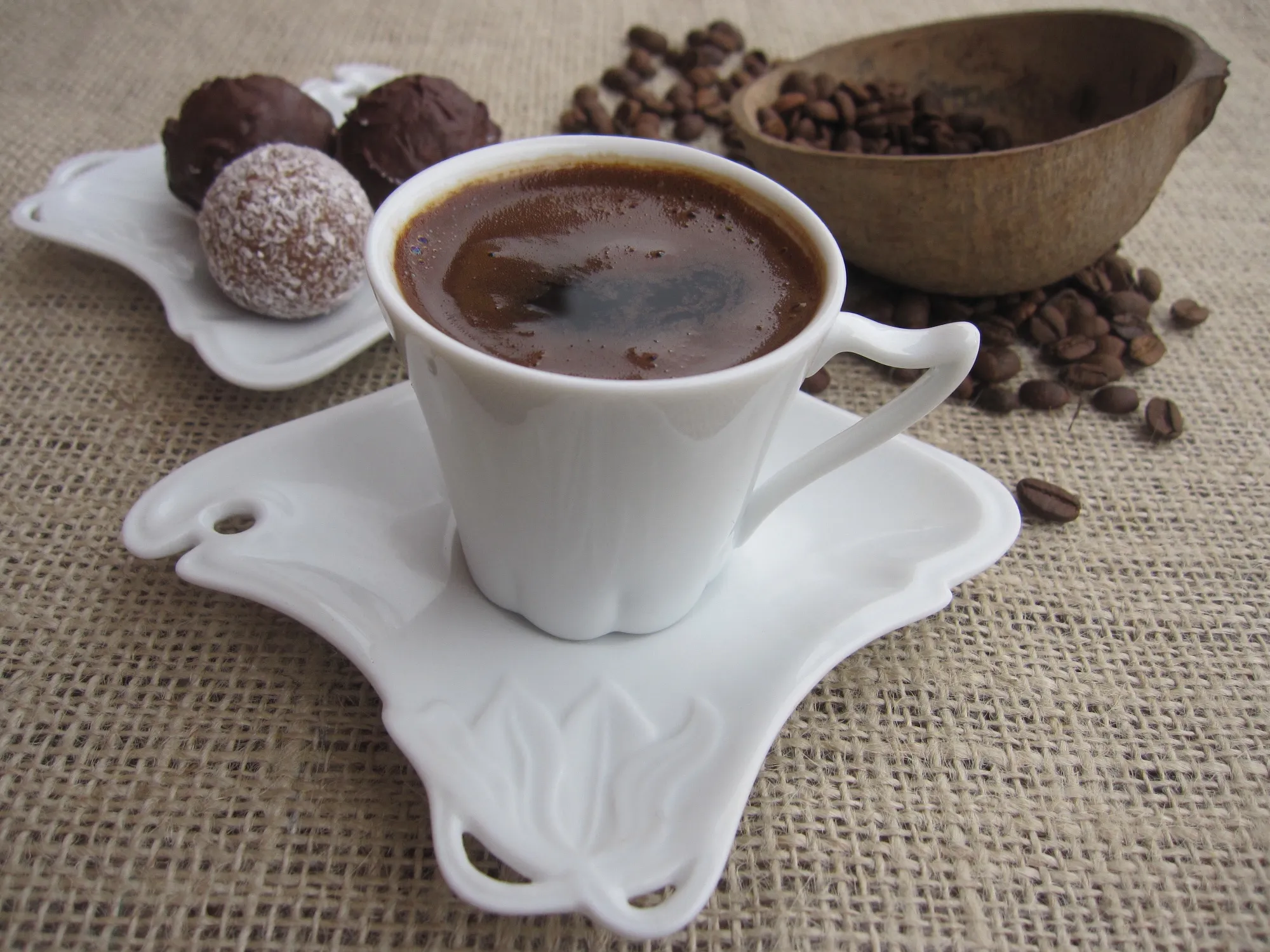
The best-known Albanian drink is raki, a strong fruit brandy that is the national spirit, but daily life runs on coffee. Around these two there is a whole family of drinks: boza, a thick fermented grain drink once made famous by Albanian boza makers across the Ottoman Empire; çaj mali, mountain tea picked on the high slopes; wine from native grapes; beer from breweries in Korçë and Tirana; and dhallë, yogurt thinned with water for hot days.
This guide explains each of them, where they come from and when Albanians drink them.
Raki: the national spirit
Raki is a clear brandy distilled from fermented fruit. Wikipedia calls it the national spirit, and it is poured at weddings and at wakes.
What it is made from
According to a 2012 report by Balkan Insight, raki is made from grapes on the coast, from plums almost everywhere, and from mulberries or even walnuts in the mountains. After distilling, it can be flavoured with herbs, honey, sour cherries or walnuts. Commercial raki is about 40% alcohol; homemade raki can reach about 60%, and double-distilled raki goes higher still.
| Type | What it is | Where |
|---|---|---|
| Raki rrushi | Grape raki, the most common | Coast and wine areas, Skrapar |
| Raki kumbulle | Plum raki | Widespread |
| Raki mani | Mulberry raki | Boboshticë and Drenovë near Korçë |
| Raki rigoni | Raki distilled with wild oregano | Përmet, especially Dangëlli |
| Raki e pjekur | Raki heated with honey or sugar | Served to older people, by tradition |
| Raki dëllinje | Juniper raki | Named on Wikipedia, no region given |
Home distilling
Many Albanians make their own raki and distrust the industrial kind. When the government drafted a new excise law in 2012, Balkan Insight reported that home stills would have to be registered, with tax above 100 litres a year and fines for those who did not comply. Tirana Times reported even higher fines. We could not confirm how the final law was applied, so we do not give figures as current.
Mulberry and oregano raki
Two rakis are protected by Slow Food’s Ark of Taste:
- Mulberry raki of Boboshticë. The national heritage register describes how berries are gathered in July and August, fermented for about two weeks and distilled in a copper still sealed with dough. Strength is judged by the chain of bubbles that forms when the glass is shaken. The register describes a single distillation; the Ark of Taste entry speaks of two.
- Raki rigoni of Përmet. About 10 to 15 kilograms of wild white oregano are fermented in about 50 litres of water for some ten days, then distilled. It is made only in households and is at risk of disappearing. By tradition it was drunk in hard winters and for respiratory ailments.
Raki in life events
The national heritage register records raki at both ends of life. At a Zadrima wedding, guests are welcomed with tobacco and raki; in Korçë, the road is sprinkled with raki as the couple leaves. At a wake in Korçë, coffee and raki are served to the men.
The ritual toast that goes with raki has its own name: dollia, led by a dollibash, the master of toasts. It belongs mainly to the south, in areas such as Skrapar, Përmet and Mokra. In July 2025 dollia was declared part of Albania’s national cultural heritage.
Boza: the Ottoman grain drink
Boza is a thick, pale drink made from fermented grain, slightly sour and slightly sweet, with about 1% alcohol or less. In Albania and Kosovo it is made with maize, often mixed with wheat.
Albanians have a special place in its history. In the seventeenth century the Ottoman traveller Evliya Çelebi described a sweet, alcohol-free, milk-white boza made mostly by Albanians. The Hürriyet Daily News writes that Albanians made the sweet boza favoured at the imperial palace, while Armenians made a sour kind. The most famous boza shop in Istanbul, Vefa Bozacısı, was founded by two brothers of an Albanian family, in 1876 according to most sources (one gives 1867). It still serves boza with cinnamon and roasted chickpeas. The Bulgarian magazine Vagabond adds that Albanian boza makers worked all over the Balkans until the middle of the twentieth century, and that Albanian maize boza is lighter than the Bulgarian millet kind.
The season depends on the country. In Turkey boza is a winter drink; in Kosovo it is a summer refreshment; in Albania it is sold all year. Wikipedia notes that in Albania it is widely drunk with desserts, which makes it a natural partner for baklava or revani.
Coffee: the daily ritual
If raki marks the big occasions, coffee marks every day. Espresso, macchiato and cappuccino are the usual orders in cafés, and Turkish coffee, kafe turke, is common because of the Ottoman past.
The numbers are unusual. One calculation based on official statistics counted 654 bars and cafés per 100,000 inhabitants; Exit News gave 518 in 2020. Either way, on 2020 Eurostat data Albania ranked third in Europe for cafés per person, after Portugal and Greece. Yet Euronews Albania reports that Albanians drink only about 3.1 kilograms of coffee per person a year, the lowest in the region. The café is a place to meet rather than to drink a lot: Exit News notes that socialising and politics happen over coffee.
In Përmet and Gjirokastër the national heritage register records the stone coffee ritual: beans roasted in a small metal cylinder, pounded in a stone mortar and served with Turkish delight to welcome guests, especially among women in the afternoon. Euronews Albania reported in 2026 that the ritual is now also offered to tourists in Gjirokastër.
Coffee is also the drink of mourning. In Korçë, at the remembrance gatherings after seven or nine days, forty days and a year, it is coffee that is offered.
Çaj mali: mountain tea
Çaj mali, mountain tea, is the most popular herbal tea in Albania. It is made from the dried flowering stems of Sideritis raeseri, known in English as ironwort. Slow Food records that it grows above 800 metres in the Gjirokastër, Korçë, Shkodër and Vlorë regions and is harvested in May and June, cut with a knife rather than pulled up.
It is sold loose in markets and, in the last twenty years, in packets in supermarkets. It is also grown from seed in gardens, which matters: Slow Food reports a sharp decline of wild plants through early and careless harvesting, and a 2023 scientific paper lists the species as endangered in Albania. Albania exports medicinal and aromatic plants on a large scale: according to an Associated Press report, 24 companies exported about 17,000 tonnes worth 40 million dollars in 2016.
By tradition, mountain tea is drunk for digestion and colds. These are traditional uses reported by Slow Food, not proven medical effects.
Wine: an old tradition, a new start
Albania joined the International Organisation of Vine and Wine (OIV) in 2023 as its fiftieth member. The OIV counted 11,339 hectares of vineyards in 2022 and about 70 wineries, and dates winemaking in the area back more than 2,000 years, to the Illyrians.
Under communism wine was mostly made by state enterprises. Today many producers work with native grapes, studied in a 2015 paper in the journal Vitis:
| Grape | Colour | Area |
|---|---|---|
| Shesh i Zi | Red | Tirana area |
| Shesh i Bardhë | White | Tirana area |
| Kallmet | Red | Zadrima, north |
| Vlosh | Red | Vlorë, Narta |
| Debinë | White | South |
| Pulës | White | South |
The main wine areas are Berat, Korçë, Tirana, Durrës, the area between Lezhë and Shkodër, and Përmet.
Beer
Birra Korça, founded in 1928, is the oldest brewery in the country. Since 2007 Korçë has held a beer festival every summer in its main squares; the 2025 edition was the nineteenth, and the National Tourism Agency calls it one of the largest summer festivals in Albania. Birra Tirana was founded in 1960 and began brewing in 1961, while Birra Stela dates from 1994.
Other drinks
- Dhallë: yogurt thinned with water or milk, sometimes salted, popular in summer. It is similar to Turkish ayran.
- Skënderbeu cognac: a grape brandy aged in oak, first produced in 1967 by a state winery and still made today.
When Albanians drink what
| Moment | Drink |
|---|---|
| Morning | Coffee, milk or tea |
| Afternoon visit | Coffee, sometimes stone coffee in the south |
| Colds, by tradition | Çaj mali; raki rigoni in Përmet |
| Summer | Dhallë; boza in Kosovo |
| Wedding or feast | Raki, with dollia toasts in the south |
| Mourning | Coffee, and raki for the men at Korçë wakes |
For what to eat with all this, start with our guide to Albanian food, our guide to Albanian desserts and our guide to the Albanian breakfast.
Frequently asked questions
What is the national drink of Albania?
Raki, a fruit brandy distilled mostly from grapes or plums, and in some mountain areas from mulberries. Commercial raki is around 40% alcohol; homemade raki is often stronger.
What is boza?
A thick, slightly sweet and slightly sour drink made from fermented grain, with very little alcohol. Albanian boza is made with maize, sometimes mixed with wheat, and under the Ottomans Albanian boza makers were known for the sweet kind.
What is çaj mali?
Mountain tea: the dried flowering stems of Sideritis raeseri, a plant that grows above 800 metres in southern and northern Albania. It is the most popular herbal tea in the country.
What coffee do Albanians drink?
Mostly espresso and drinks based on it, such as macchiato and cappuccino, along with Turkish coffee, which is common because of the Ottoman past. In Përmet and Gjirokastër there is also a tradition of coffee pounded in a stone mortar.
Is Albanian wine any good?
We have not tasted it, so we cannot judge. What we can say is that Albania joined the International Organisation of Vine and Wine in 2023, has about 70 wineries and grows native grapes such as Shesh i Zi, Kallmet and Vlosh.
Sources
- Albanian cuisine, Wikipedia
- Besar Likmeta, Albanians Risk Fines on Homemade Hooch, Balkan Insight (2012)
- Tirana Times, New excise law to enter into force next October (2012)
- Rakia, Wikipedia
- Raki Rigoni, Ark of Taste, Slow Food Foundation for Biodiversity
- Boboshtica mulberry raki, Ark of Taste, Slow Food Foundation for Biodiversity
- The extraction of mulberry raki, National Register of Intangible Cultural Heritage of Albania
- The funeral ceremony, Korçë, National Register of Intangible Cultural Heritage of Albania
- Zadrima wedding, National Register of Intangible Cultural Heritage of Albania
- Dollia declared national cultural heritage, Top Channel (2025, in Albanian)
- Boza, Wikipedia
- Niki Gamm, The Ottomans' favorite winter drink: boza, Hürriyet Daily News (2015)
- Suna Çağaptay, Istanbul's most beguiling cocktail, New Lines Magazine (2021)
- What is boza?, Vagabond
- The stone coffee ritual, National Register of Intangible Cultural Heritage of Albania
- Albania exceeds Italy and Spain for cafés per inhabitant, Periskopi (2023)
- Albania, the country with the most bars per inhabitant, Periskopi (2018)
- COVID-19 didn't quench Albanians' taste for coffee, Exit News (2020)
- Stone-brewed coffee, an experience attracting foreign tourists in Gjirokastër, Euronews Albania (2026)
- Coffee imports hit record high, Euronews Albania (2025)
- Mountain tea, Ark of Taste, Slow Food Foundation for Biodiversity
- Sota et al., Micropropagation of ironwort (Sideritis raeseri), Acta agriculturae Slovenica 119/2 (2023)
- Costas Kantouris, Associated Press report on Albanian herb exports, Macau Daily Times (2017)
- Albania becomes the 50th OIV Member State, International Organisation of Vine and Wine (2023)
- Kullaj et al., Albanian native grape cultivars, Vitis 54 (2015)
- Albanian wine, Wikipedia
- Birra Korça, Wikipedia
- Birra Tirana, Wikipedia
- Birra Stela, Wikipedia
- Korça Beer Fest, edition XIX, National Tourism Agency of Albania
- Cognac Skënderbeu, Wikipedia