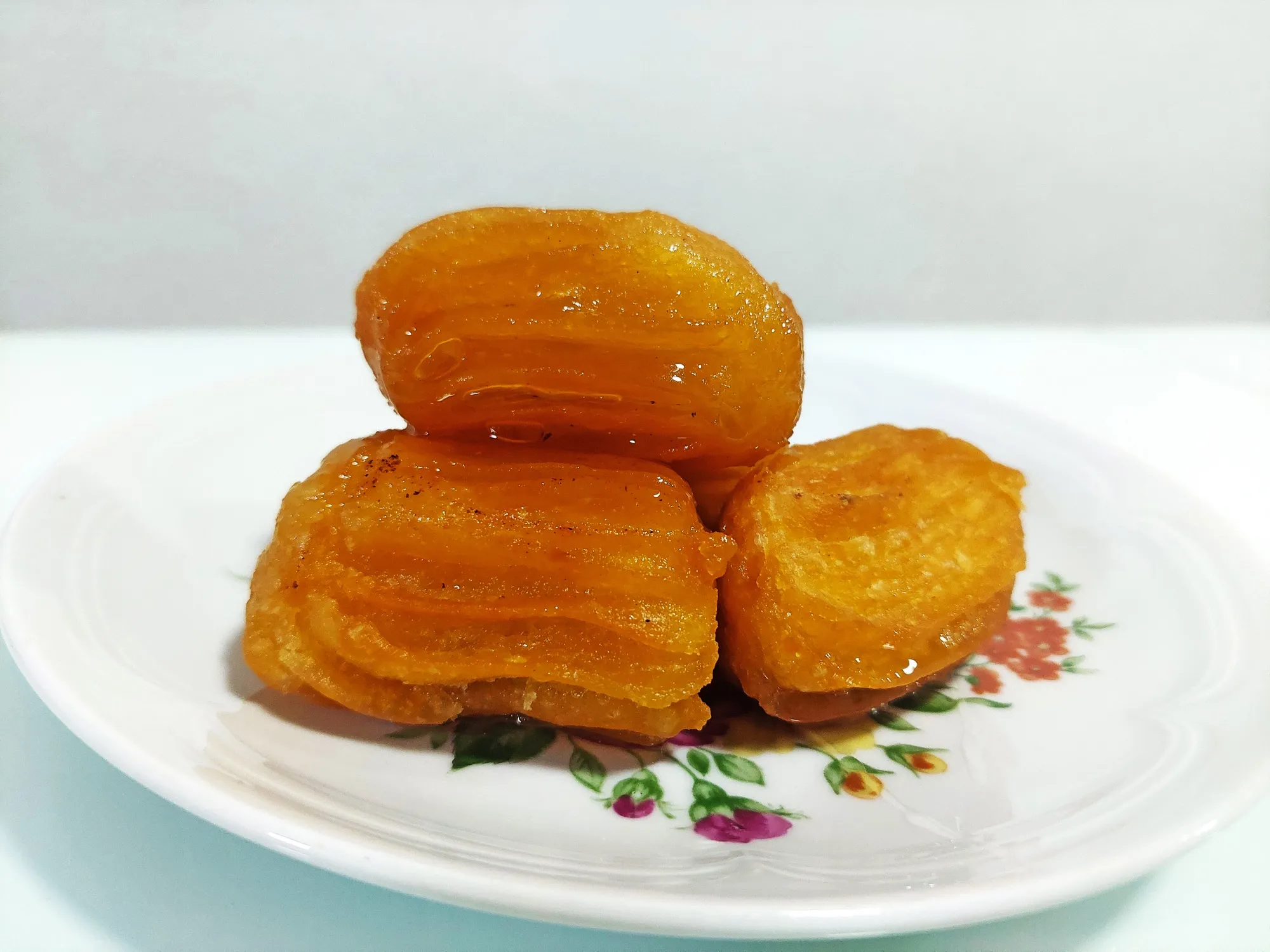
Tulumba: Crisp Fried Pastry Soaked in Syrup
Tulumba recipe, Albanian style: choux-like dough piped through a star nozzle, fried slowly until crisp and dipped hot into cold lemon syrup.
- Prep30 min
- Cook1 h
- Rest1 h
- Serves10
- DifficultyMedium
Ingredients
For the syrup
For the dough
For frying
Method
- Make the syrup first, because it must be completely cold: bring the sugar and water to the boil and simmer for 8 to 10 minutes. Add the lemon juice, take off the heat and leave to cool, ideally in the fridge.
- Put the water, butter, sugar and salt in a pan and heat until the butter has melted and the water comes to the boil.
- Lower the heat, tip in all the flour at once and stir quickly with a wooden spoon so that no lumps form.
- Cook the dough over low heat for 4 to 5 minutes, stirring constantly, until it comes away from the sides of the pan, gathers into a ball and leaves a thin film on the bottom.
- Transfer the dough to a bowl and spread it out a little. Leave it for 10 to 15 minutes, until just warm: if the eggs go into very hot dough, they cook and the dough dries out.
- Beat in the eggs one at a time, with a wooden spoon or an electric mixer, waiting until each is absorbed before adding the next. Add the last egg a little at a time: the dough should be thick, glossy and slightly elastic, so that it holds its shape when piped.
- Spoon the dough into a piping bag fitted with a large open star nozzle, about 1.5 cm (5/8 in); do not overfill the bag.
- In a wide pan, heat the oil over medium heat to about 160°C (320°F): hot, but not smoking.
- Pipe the dough straight into the oil, cutting it into 5 to 6 cm (2 to 2 1/4 in) lengths with oiled scissors. Do not crowd the pan: they puff up and need room.
- Fry for 10 to 15 minutes, turning now and then, until they float, puff up and are golden on all sides. If they colour quickly, turn the heat down, or they will stay raw inside.
- Lift them out with a slotted spoon, drain briefly and drop them, still hot, into the cold syrup. Leave for 3 to 5 minutes, turning them, then transfer to a deep dish.
- Let the oil come back to temperature before each new batch. At the end, pour a little of the leftover syrup over the tulumba and serve them cold.
Background and tips
Tulumba (in Albanian tullumba or tollumba, say “too-LOOM-bah”) are ridged fingers of choux-like dough, piped through a star nozzle, fried and soaked in syrup. They are made across the Balkans and Turkey: in Turkey they are tulumba tatlısı, in Bosnia and Serbia tulumbe. The Turkish word means “pump”, from the Italian tromba, after the tool used to press out the dough. In Albania and Kosovo they are sold in pastry shops and also made at home. Other syrup-soaked sweets are in our guide to Albanian desserts.
Oil not too hot. The most common mistake is oil that is too hot: the tulumba brown quickly and stay soggy inside. A Turkish study from 2002 found that at around 155°C (311°F) during frying they cook through in about 13 minutes and absorb the least oil, while at 150°C (302°F) they soak up more. Many Turkish and Balkan recipes start with warm oil and raise the heat. The dough also needs proper cooking on the stove, until it gathers into a ball: otherwise the tulumba come out soft instead of crisp.
Hot into cold syrup. On this the recipes almost all agree: the tulumba come out of the oil hot and go into completely cold syrup for a few minutes, so that they absorb it and stay crisp outside. Unlike baklava or revani, which are baked and have syrup poured over them, tulumba are fried and dipped. The dough is cooked on the stove like that of tespixhe, but with water and many more eggs. With kompekaj, a sponge baked between pastry sheets, they share only the syrup.
Albanian, Turkish, Balkan. The Albanian recipes we read use butter and no semolina or starch; Turkish ones often add a spoonful of fine semolina and sprinkle the tulumba with chopped pistachios, while Bosnian and Serbian ones use oil and leave them in the syrup longer, until soft. In Kosovo the dough is often made with oil, a little cornflour (cornstarch) and baking powder, the syrup is flavoured with lemon and vanilla sugar, and tulumba are served at Bajram. Without a piping bag, drop small balls of dough into the oil with two oiled spoons. Serve cold, with a little grated lemon or orange zest on top.