Is Albanian Food Mediterranean? Diet and Health
How Albanian cooking fits the Mediterranean diet: olive oil, vegetables, beans and yogurt, what the evidence says and what the Albanian paradox was.
Published
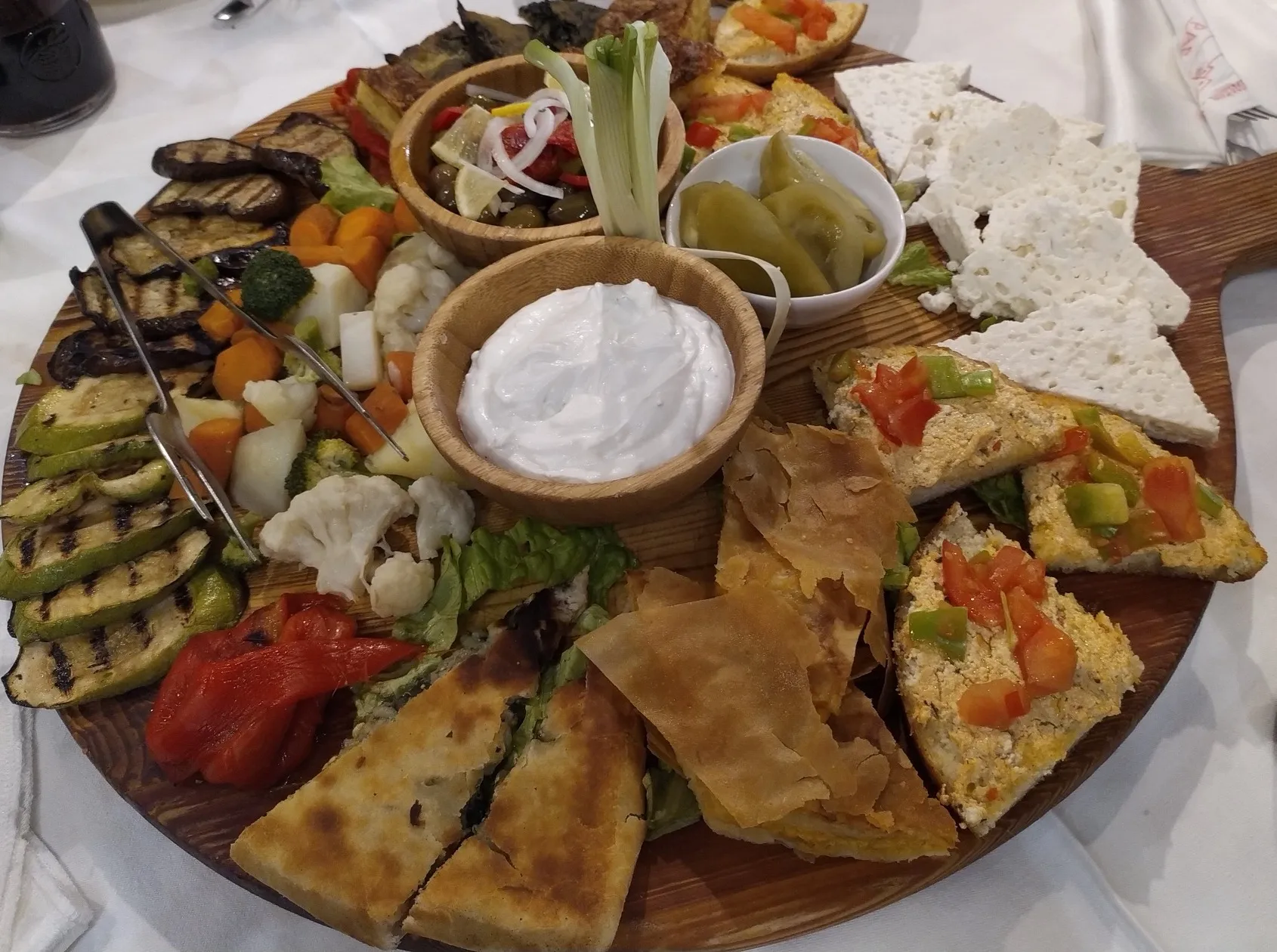
Albanian cooking is built from the same ingredients as the Mediterranean diet, olive oil, vegetables, beans, yogurt, cheese, bread and some fish, even though Albania is not among the seven countries in UNESCO’s 2013 listing. In the 1990s researchers even used Albania as an example: poor, yet with low adult heart disease mortality, which they suggested diet might help explain. Whether a given Albanian meal fits the pattern depends on what is on the plate: a pot of beans with salad does; a tavë kosi with plenty of butter, eaten daily, less so.
This guide explains what the Mediterranean diet is, what the evidence says, what we know about Albania then and now, and which Albanian dishes match the pattern best.
This is general information, not medical advice. For diets linked to a health condition, talk to your doctor or a registered dietitian.
What the Mediterranean diet is
Harvard’s Nutrition Source describes it as a mostly plant-based way of eating: whole grains, olive oil, fruit, vegetables, beans and other legumes, nuts, herbs and spices. Fish is the preferred animal protein; poultry, eggs, cheese and yogurt come in moderate amounts; red meat only a few times a month. Water is the main drink, wine is moderate and with meals, and physical activity and shared meals are part of it. The model comes from the 1993 Mediterranean Diet Pyramid, based on how people ate in Crete and southern Italy in the mid twentieth century. It is a pattern, not a diet with fixed portions.
UNESCO added the Mediterranean diet to its Representative List of Intangible Cultural Heritage in 2013 on behalf of Croatia, Cyprus, Greece, Italy, Morocco, Portugal and Spain. UNESCO describes it as a set of skills, knowledge, rituals and traditions, from growing food to sharing it at the table. Albania is not in the listing.
What the evidence says
Observational studies. People who follow the Mediterranean pattern more closely tend, on average, to have less cardiovascular disease. Harvard cites a meta-analysis of 16 cohorts with more than 22,000 women: those with the highest adherence had a 24% lower risk of cardiovascular disease and a 23% lower risk of premature death. These are associations: people who eat this way may differ in other habits too.
A clinical trial. PREDIMED, in Spain, randomly assigned 7,447 adults aged 55 to 80, at high cardiovascular risk but without heart disease, to a Mediterranean diet with extra-virgin olive oil, a Mediterranean diet with nuts, or a reduced-fat diet. After a median of 4.8 years, both Mediterranean groups had fewer heart attacks, strokes and cardiovascular deaths combined (hazard ratios 0.69 and 0.72). The original 2013 paper was retracted for problems with randomisation and republished in 2018 with new analyses, which is the version we cite.
Olive oil and the EU rules. Olive oil is mostly monounsaturated fat: per 100 g, USDA lists 13.8 g of saturated fat and 73 g of monounsaturated. The EU allows foods high in unsaturated fat to say that replacing saturated fats with unsaturated fats in the diet contributes to the maintenance of normal blood cholesterol levels. That is the claim; anything stronger, such as olive oil “protecting the heart”, is not authorised. A separate claim on olive oil polyphenols applies only to oils with a measured minimum content, so it cannot be used for olive oil in general.
The Albanian paradox
In 1997 Arjan Gjonça and Martin Bobak published a short paper in The Lancet with a striking question in the title: was Albania another example of the protective effect of a Mediterranean lifestyle? Using 1990 mortality data, corrected for under-registration, they found that infant mortality was among the highest in Europe, as expected for a very poor country. Adult mortality, though, was similar to other Mediterranean countries. Coronary heart disease mortality in men aged 0 to 64 was 41 per 100,000, less than half the UK rate and similar to Italy.
They also noted that in 1978 mortality was lowest in the south-west, where more olive oil, fruit and vegetables were produced and eaten. Their suggestion was that the Albanian diet of the time, low in total fat, meat and dairy and high in fruit, vegetables and carbohydrates, might help explain the pattern.
Two cautions matter. This was an ecological study on population data, which can suggest hypotheses but not prove them. And it describes Albania in 1990, a closed and poor country, not the way people eat today.
Albania today
Diets change with incomes and cities. According to the WHO Global Health Observatory, the age-standardised share of Albanian adults with obesity was an estimated 24.1% in 2024, up from 23.0% in 2022. That says nothing about any single dish, but it is a reminder that the 1990 picture should not be read as a portrait of the present.
Olives remain part of the landscape. INSTAT counted 143,383 tonnes of olives harvested in 2025, 2.3% less than in 2024, with Fier, Elbasan, Berat and Vlorë producing 83.2% of the total. These are tonnes of olives, not of oil: INSTAT does not give an oil figure in that report.
Which Albanian dishes fit the pattern
The everyday Albanian table has many dishes that match the Mediterranean model closely:
- Beans and lentils. Bean stew and lentil stew are legume dishes cooked with olive oil and vegetables. Our guide to Albanian beans and lentils covers them in detail.
- Vegetables cooked in oil. Stuffed peppers, stuffed eggplant, okra stew, leek stew and vegetable soup put vegetables at the centre, with meat as flavour or not at all.
- Fish. Baked fish from the coast and the lakes.
- Yogurt. Plain kos, tarator and dhallë; see our guide to kos and dhallë.
- Leaves and grains. Japrak, vine leaves filled with rice, and spinach byrek, better when brushed with olive oil.
- Pickles. Turshi adds vegetables in winter, along with salt, so a small bowl is enough.
The dishes that sit further from the pattern are the festive and rich ones: plenty of butter, salty cheese, red meat and syrup desserts. They belong to Albanian cooking just as much. Our guide to lighter Albanian dishes shows how to trim butter and salt in tavë kosi, byrek and fërgesë without losing what makes them good.
The WHO basics
WHO’s healthy diet advice lines up well with this way of cooking:
- at least 400 g of fruit and vegetables a day;
- at least 25 g of naturally occurring fibre a day, from whole grains, vegetables, fruit and legumes;
- saturated fat under 10% of energy, preferring unsaturated fats such as olive oil;
- free sugars under 10% of energy;
- less than 5 g of salt a day.
If you read Albanian, efarma.al has a clear article on foods high in cholesterol, explaining saturated and unsaturated fats, soluble fibre from beans and the place of olive oil.
What this guide does not say
It does not say that Albanian food is healthier than any other, that olive oil cures anything, or that eating this way will make you lose weight. It says that the traditional everyday Albanian table shares the ingredients and habits of the Mediterranean diet, and that the evidence for that diet, while not a guarantee, is among the strongest in nutrition.
If you are changing your diet because of a heart condition, diabetes or another health problem, do it with your doctor or a registered dietitian.
Frequently asked questions
Is Albanian food part of the Mediterranean diet?
Albania is not one of the seven countries named in the 2013 UNESCO listing of the Mediterranean diet, but its cooking uses the same building blocks: olive oil, vegetables, beans, yogurt, cheese and bread, with meat often in smaller amounts. Many everyday dishes fit the pattern; festive ones are richer.
What was the Albanian paradox?
A 1997 study in The Lancet noted that in 1990 Albania was one of Europe's poorest countries, yet adult mortality from heart disease was low, similar to Italy and under half the UK's. The authors suggested diet might help explain it: little meat and dairy, a lot of fruit, vegetables and carbohydrates. It was a hypothesis, not proof.
Is the Mediterranean diet proven to be healthy?
Observational studies link it with lower cardiovascular risk, and one large trial in Spain, PREDIMED, found fewer heart attacks, strokes and cardiovascular deaths in high-risk adults on a Mediterranean diet with extra olive oil or nuts than on a low-fat diet. It is a dietary pattern, not a cure.
Is olive oil healthier than butter?
Olive oil is mostly unsaturated fat. The EU-authorised wording is that replacing saturated fats with unsaturated fats in the diet contributes to the maintenance of normal blood cholesterol levels. Per 100 g, USDA lists 14 g of saturated fat in olive oil and 51 g in butter.
Sources
- Diet Review: Mediterranean Diet, The Nutrition Source, Harvard T.H. Chan School of Public Health (2023)
- Mediterranean diet, Representative List of the Intangible Cultural Heritage of Humanity, UNESCO (2013)
- Estruch et al., Primary Prevention of Cardiovascular Disease with a Mediterranean Diet Supplemented with Extra-Virgin Olive Oil or Nuts, New England Journal of Medicine (2018)
- Gjonça, Bobak, Albanian paradox, another example of protective effect of Mediterranean lifestyle?, The Lancet (1997)
- Healthy diet, World Health Organization (2026)
- Obesity among adults, BMI 30 or more, age-standardized estimate, WHO Global Health Observatory
- Agricultural Statistics 2025, INSTAT (2026)
- Commission Regulation (EU) No 432/2012, list of permitted health claims, EUR-Lex
- USDA FoodData Central, SR Legacy: Oil, olive, salad or cooking (FDC 171413)
- CREA, Tabelle di composizione degli alimenti: Olio di oliva extra vergine (009210)