Albanian Beans and Lentils: Fasule and Thjerrëza
Beans and lentils in Albanian cooking: protein, fibre and iron per 100 g, how much to eat, how to soak and boil dried beans safely, and recipes.
Published
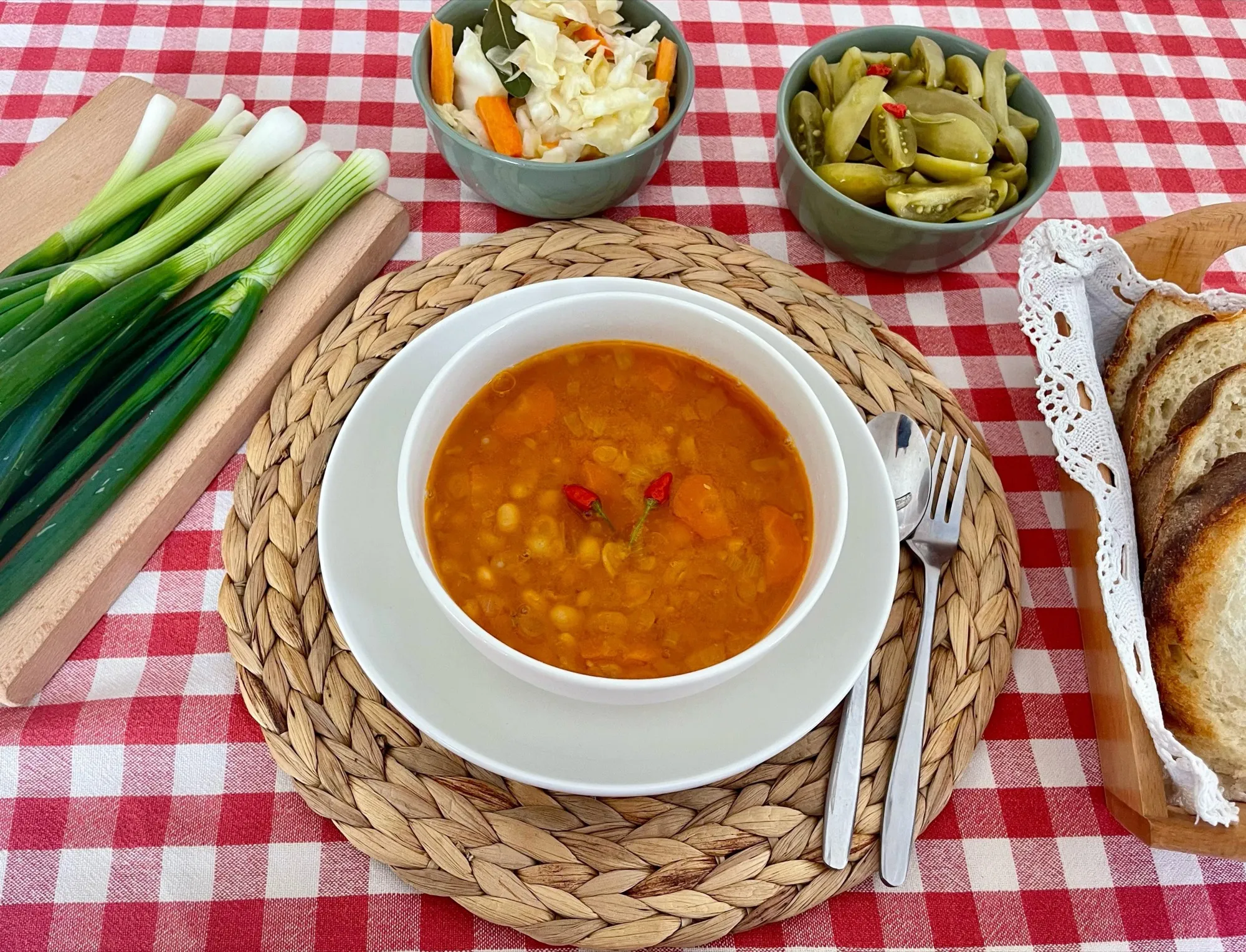
Beans and lentils are the everyday protein of the Albanian kitchen: fasule (white beans; groshë is another Albanian word for beans) cooked into jani, and thjerrëza (lentils) cooked into a thick stew. Per 100 g cooked, white beans give about 9.7 g of protein and 6.3 g of fibre, and lentils about 9 g of protein and 7.9 g of fibre, according to USDA data. Dried beans must be soaked and boiled properly before eating: the safety rules are below, with what the evidence says about legumes and health.
This is general information, not medical advice. If you have kidney disease, a bowel condition, gout, or follow a special diet, ask your doctor or a registered dietitian how legumes fit.
Legumes in Albanian cooking
The pot of beans is one of the most ordinary meals in Albania. Our jani me fasule simmers dried white beans with onion, garlic, tomato paste, paprika and bay until thick, with or without cured meat. Thjerrëza is a lentil stew with onion, carrot, celery, potato and tomato, finished with a splash of vinegar. Our recipes suggest serving them hot with bread and turshi, Albanian pickles.
The words change across the country: besides fasule you will also hear groshë, and our guide to regional cuisine follows the dishes of each area.
FAO defines pulses as the dry edible seeds of legume plants. It also notes that they fix nitrogen in the soil, which is one reason World Pulses Day, every 10 February, grew out of the 2016 International Year of Pulses.
What 100 g of cooked legumes contain
Values per 100 g, cooked by boiling. USDA FoodData Central (SR Legacy) counts fibre inside carbohydrates; the Italian CREA tables count it separately, so the carbohydrate columns are not comparable. Cooked values also vary with how much water the legumes absorb, which is why the two databases disagree.
| Per 100 g, boiled | Energy | Protein | Fat | Fibre | Iron |
|---|---|---|---|---|---|
| White beans (USDA) | 139 kcal | 9.7 g | 0.4 g | 6.3 g | 3.7 mg |
| Cannellini beans (CREA) | 107 kcal | 8.0 g | 0.4 g | 7.8 g | 1.7 mg |
| Lentils (USDA) | 116 kcal | 9.0 g | 0.4 g | 7.9 g | 3.3 mg |
| Lentils (CREA) | 109 kcal | 6.9 g | 0.4 g | 8.3 g | 3.0 mg |
| Chickpeas (USDA) | 164 kcal | 8.9 g | 2.6 g | 7.6 g | 2.9 mg |
| Chickpeas (CREA) | 132 kcal | 7.0 g | 2.4 g | 5.8 g | 2.2 mg |
Legumes are low in fat and high in fibre. A portion of 150 g of cooked beans gives roughly 9 to 12 g of fibre by these figures, a good share of the 25 g a day that EFSA considers adequate for normal bowel function in adults and that WHO recommends as a minimum.
Protein, fibre and iron
Harvard’s Nutrition Source lists legumes as a source of protein, folate, soluble and insoluble fibre, iron and phosphorus. The Italian CREA guidelines add a useful point: legumes eaten with cereals, such as bread, rice or pasta, give a protein mix whose quality is comparable to animal protein.
WHO’s healthy diet advice puts lentils, chickpeas, beans and dried peas among the main sources of carbohydrate, with whole grains, vegetables and fruit, and mentions beans alongside lean meat for iron.
On iron, efarma.al has an article in Albanian on iron-deficiency anaemia and how to read the tests, which lists legumes among dietary sources and explains why iron tablets alone do not treat the cause. Anaemia needs a diagnosis: do not treat it yourself with diet or supplements.
What the evidence says
Harvard summarises a meta-analysis, mostly of observational studies, in which eating legumes about four times a week was associated with a 14% lower risk of coronary heart disease. In clinical trials, eating legumes lowered total and LDL cholesterol. On type 2 diabetes, Harvard says there is not yet a definitive answer.
These results support legumes as part of a healthy diet. They do not make a bowl of beans a treatment.
How much and how often
The Italian CREA guidelines, which give clear portion sizes, suggest:
- a portion of 150 g of legumes, fresh, frozen, soaked, canned and drained, or home-cooked; or 50 g if weighed dry;
- at least three portions a week.
Green beans count as a vegetable, not as a legume. In the UK, the NHS counts 80 g of beans or pulses as one of your 5 A Day, but only once a day however much you eat.
Soaking and boiling dried beans safely
Raw and undercooked beans contain a lectin called phytohaemagglutinin. The FDA explains that at high levels it can cause nausea, severe vomiting and diarrhoea, while canned and properly cooked beans are safe. Health Canada says symptoms usually start 1 to 3 hours after eating, and that most cases come from red kidney beans, which contain more of this lectin than other legumes.
The official advice:
- Soak dried beans for at least 5 hours in two or three times their volume of water (FDA, Health Canada). Throw the soaking water away.
- Boil in fresh water. Health Canada says to boil vigorously for at least 10 minutes; the FDA says to boil for at least 30 minutes. Our jani recipe soaks the beans for 12 hours, boils them for 10 minutes in fresh water, throws that water away and then simmers them for 60 to 90 minutes.
- Do not use a slow cooker from raw. Health Canada warns that slow cookers do not get hot enough to destroy the lectin. Boil the beans first.
- Canned beans are already cooked and need no further boiling (Health Canada).
Lentils cook without soaking and are quicker; the safety advice above is written for dried beans.
Gas and comfort
Beans are known for causing wind. Harvard notes that soaking and cooking may help. The Italian CREA explains that the sugars responsible, galacto-oligosaccharides in the skins, are not removed by cooking, and suggests three practical tricks: pass the beans through a sieve or food mill, choose skinless legumes such as red lentils, and increase the amount slowly so your body gets used to them. Bloating that is severe or new is a reason to see a doctor.
Recipes on the site
- Jani me fasule, the Albanian white bean stew.
- Thjerrëza, meat-free lentil stew.
- Vegetable soup, to which a handful of cooked beans can be added.
For the wider picture, see our guides to the Mediterranean diet in Albania and to lighter Albanian dishes.
For specific dietary needs, including kidney disease, irritable bowel syndrome or iron deficiency, follow the advice of your doctor or a registered dietitian.
Frequently asked questions
How much protein is in cooked white beans?
About 9.7 g per 100 g of white beans boiled without salt in USDA data, and 8.0 g per 100 g of cooked cannellini in the Italian CREA tables. Values differ because cooked beans hold different amounts of water.
Do I have to soak dried beans?
For safety, yes. Raw or undercooked beans contain a lectin, phytohaemagglutinin, that can cause severe vomiting. The FDA advises soaking for at least 5 hours, then boiling in fresh water for at least 30 minutes. Canned beans are already cooked.
How often should I eat legumes?
The Italian CREA guidelines suggest at least three portions a week, a portion being 150 g of cooked legumes or 50 g dried. Harvard reports that eating legumes about four times a week was associated with a 14% lower risk of coronary heart disease in mostly observational studies.
What is groshë?
Another Albanian word for beans, used in some areas instead of fasule. A pot of groshë or fasule is the same idea: dried beans slowly cooked with oil, onion and tomato or paprika.
How can I reduce gas from beans?
Harvard says soaking and cooking may help. The Italian CREA notes that the sugars responsible, in the skins, are not removed by cooking, and suggests sieving the beans, choosing skinless legumes such as red lentils, and increasing the amount gradually.
Sources
- Legumes and Pulses, The Nutrition Source, Harvard T.H. Chan School of Public Health
- World Pulses Day, FAO
- Healthy diet, World Health Organization (2026)
- EFSA sets European dietary reference values for nutrient intakes, EFSA (2010)
- Legumi, Sapermangiare, CREA Alimenti e Nutrizione
- Le giuste porzioni e le frequenze di consumo consigliate, Sapermangiare, CREA Alimenti e Nutrizione
- Natural Toxins in Food, U.S. Food and Drug Administration (2024)
- Lectins in Dry Legumes, Health Canada (2011)
- 5 A Day: what counts?, NHS (2026)
- USDA FoodData Central, SR Legacy: Beans, white, cooked, boiled, without salt (FDC 175203); Lentils, cooked, boiled, without salt (172421); Chickpeas, cooked, boiled, without salt (173757)
- CREA, Tabelle di composizione degli alimenti: Fagioli cannellini secchi, cotti (004205)
- CREA, Tabelle di composizione degli alimenti: Lenticchie secche, cotte (004505)
- CREA, Tabelle di composizione degli alimenti: Ceci secchi, cotti (004005)