Albanian Cheese: Gjizë, White Cheese and Kaçkavall
Albanian cheese explained: djathë i bardhë, gjizë, kaçkavall and mishavinë, how they are made, where they come from and what to use instead outside Albania.
Published
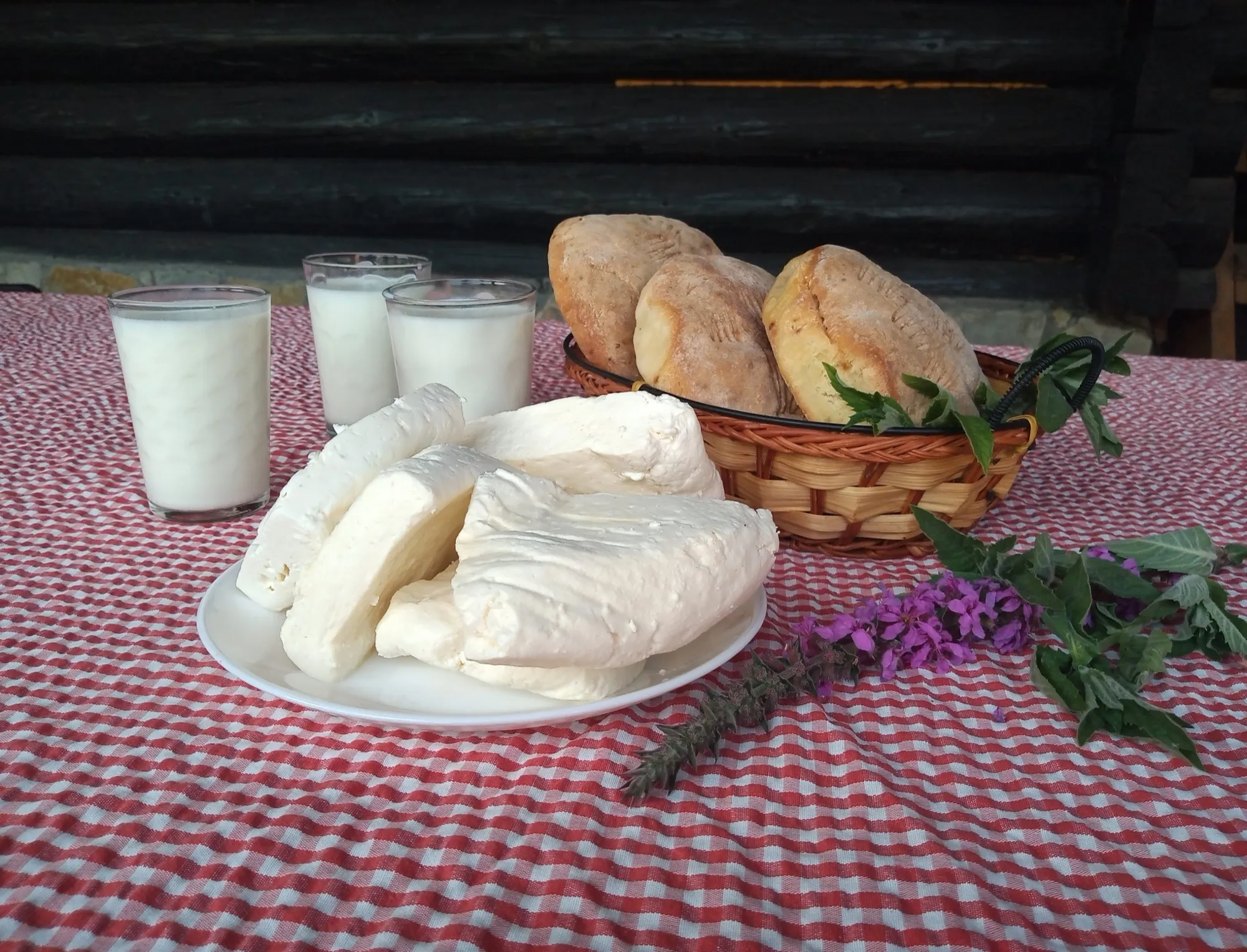
Albania’s two everyday cheeses are djathë i bardhë, a white cheese kept in brine much like feta, and kaçkavall, a firm yellow cheese; the third one every cook needs is gjizë, a fresh salted curd used in pies and baked dishes. Around them are local and mountain cheeses, the best known being mishavinë from Kelmend in the far north, protected by Slow Food. Most milk in Albania now comes from cows, but sheep and goats still matter in the south and in the mountains.
If you are here because a recipe asked for gjizë or white cheese, the substitutes come first.
What to use outside Albania
| Albanian cheese | What it is | Best substitute | Notes |
|---|---|---|---|
| Djathë i bardhë | White brined cheese, sheep or sheep and goat | Feta | Same family and similar milk rules |
| Gjizë | Fresh salted curd | 150 g dry ricotta + 100 g feta per 250 g | Our recipes use this mix |
| Kaçkavall | Firm yellow cheese | Kashkaval or young caciocavallo | Related by name, not identical |
| Mishavinë | Aged mountain cheese from Kelmend | No real equivalent | Look for it in Albanian shops |
These are practical suggestions, the same ones we use in our recipes, not official equivalents. Drain the ricotta well for an hour in a sieve: gjizë is drier than most supermarket ricotta.
Djathë i bardhë: white cheese
Djathë i bardhë simply means “white cheese”. It is a brined cheese traditionally made from sheep’s milk, or sheep’s and goat’s milk, and a 2014 study of cheese from the south found that goat’s milk is kept to at most about 30%, the same rule that applies to Greek feta. Shepherds use raw milk; dairies pasteurise it. The same study calls Gjirokastër a town well known for its white cheese, and the milk it analysed came from the Gjirokastër, Tepelenë and Vlorë areas.
White cheese is on the breakfast table with bread, butter and jam, and on the meze plate with cured meats. Our petulla are served with it.
Gjizë: the cook’s cheese
Gjizë is the cheese that Albanian recipes ask for most and that is hardest to find abroad. The Albanian Wikipedia describes the most common method: the whey left after making cheese is heated for about a quarter of an hour, vinegar or lemon juice is added, and the curds are drained in a cloth for three or four hours, then salted. It can also be made from milk, yogurt or dhallë.
Sources do not quite agree on what to call it. The National Tourism Agency translates it as “cottage cheese” or “local white cheese”, while English Wikipedia calls it “Albanian ricotta”. The real whey cheese of Albania, closest to ricotta in method, is urdhë.
Gjizë goes into:
- byrek, where the National Tourism Agency gives a pie with gjizë or spinach;
- fërgesë, the baked dish of Tirana and Gjirokastër: try our fërgesë recipe;
- lakror and other pies: see our lakror;
- baked peppers: our speca me gjizë;
- tavë dheu, the Tirana clay pot with liver: our tavë dheu recipe.
Kaçkavall: the yellow cheese
Kaçkavall is the most common cheese in Albania after white cheese, according to Wikipedia, and every dairy makes it, from cow’s or sheep’s milk and less often goat’s. The name is shared with Bulgarian kashkaval and probably comes from Italian caciocavallo.
Mishavinë and the mountain cheeses
Mishavinë is made only in summer, by 17 families in the villages of Lepushë, Budaç and Vermosh in Kelmend, from a mix of cow’s, sheep’s and goat’s milk. Slow Food places it in the family of cheeses once aged in a sack, and today it matures in pierced wooden containers sealed with melted butter. It is one of only two Slow Food Presidia in Albania, the other being the gliko of Përmet. Wikipedia traces the name to an animal skin.
In January 2023 the Ministry of Agriculture presented four products as protected and certified: mishavinë of Kelmend, Veleçik cheese, the goat’s cheese of Bjeshkët e Rrunjës, and a honey. A 2026 study lists the last two as Traditional Specialities Guaranteed. We found no Albanian cheese registered as a geographical indication in the European Union.
A 2018 list of regional products gives an idea of the variety: Korab cheese from Dibër, Stopan from Elbasan, white cheese from Sopot, Gjirokastër, Libohovë and Përmet, goat’s and cow’s cheese from Pustec near Korçë, goat’s cheese from Pukë and Fushë-Arrëz, and cheese and ricotta from Konispol. In Malësi e Madhe, the National Tourism Agency describes djathë i zier, a soft cheese heated slowly.
Cheese in a skin
A traditional way to keep cheese in the south is recorded in Albania’s national heritage register: shëllira e kaçupit, from Labëria, Kolonjë and Tepelenë, is made from salted sheep’s milk stored in a kaçup, a bag made from sheep or goat skin, where it keeps for up to eight months.
Cheese and butter were also made during transhumance, the seasonal moving of flocks between winter and summer pastures. The national register describes the cheese made on the move, and in 2023 Albania was one of ten countries that added transhumance to UNESCO’s list of intangible cultural heritage.
The numbers
INSTAT’s survey of dairies gives a picture of modern production:
| Dairies, 2025 | Amount |
|---|---|
| Milk collected | about 101,000 tonnes (+6.9%) |
| of which cow’s milk | 84,000 tonnes |
| sheep’s milk | 9,000 tonnes (−21%) |
| goat’s milk | 8,000 tonnes |
| Cheese produced | 10,688 tonnes (+1.9%) |
| Yogurt (kos) | 14,878 tonnes |
Total milk production in 2025 was about 868,000 tonnes, slightly less than in 2024, and 85.7% of it was cow’s milk. Dairies handle only about one eighth of all milk (our calculation): the rest is used on the farm, sold directly or made into cheese at home. Sheep are concentrated in the Vlorë and Gjirokastër regions. Almost half the cheese made by dairies is soft cheese.
A 2025 study of 18 dairies around Fier found weak checks on milk suppliers, testing and traceability, and no dairy with ISO certification, a reminder that much of the sector is small and artisanal.
Cooking with Albanian cheese
- Fërgesë, peppers and tomatoes baked with gjizë.
- Speca me gjizë, peppers stuffed with cheese.
- Tavë dheu, liver and curd cheese in clay.
- Spinach byrek and lakror.
- Flija, served with white cheese.
For the rest of the table, see our guide to Albanian food and our guide to the Albanian breakfast.
Frequently asked questions
What is gjizë?
A fresh, salted curd cheese used in pies, fërgesë and baked peppers. The Albanian Wikipedia describes making it by heating the whey left over from cheesemaking with vinegar or lemon and draining the curds in a cloth; it can also be made from milk or yogurt.
What can I use instead of gjizë?
A mix of dry ricotta and feta. In our recipes we use about 150 g of well-drained ricotta and 100 g of crumbled feta for every 250 g of gjizë: the ricotta gives the texture, the feta the salt.
What is djathë i bardhë?
Albanian white cheese, a brined cheese traditionally made from sheep's milk or a mix of sheep's and goat's milk. Feta is the closest substitute outside Albania.
Is kaçkavall the same as caciocavallo?
They are related by name, and Wikipedia places kashkaval among the stretched-curd cheeses like caciocavallo, but they are not the same cheese. Kaçkavall is the most common Albanian cheese after white cheese; kashkaval from Bulgarian shops or a young caciocavallo are good substitutes.
Does Albania have protected cheeses?
Not at EU level, as far as we could find. In January 2023 the Ministry of Agriculture presented mishavinë from Kelmend and two other cheeses as protected and certified national products, and Slow Food has made mishavinë one of its two Albanian Presidia.
Sources
- Milk and Dairy Products 2025, INSTAT (2026)
- Livestock Statistics 2025, INSTAT (2026)
- Mishavin, Slow Food Presidium, Slow Food Foundation for Biodiversity
- Mishavinë, Wikipedia
- Çomo, Troja, Terpo, Physical and chemical characteristics of milk and white cheese produced in southern Albania, Albanian Journal of Agricultural Sciences (2014)
- Kaçupi's brine, National Register of Intangible Cultural Heritage of Albania
- Albanian Transhumance, National Register of Intangible Cultural Heritage of Albania
- Decision 18.COM 8.B.14, Transhumance, UNESCO (2023)
- 4 brands of original cheese and honey Made in Albania, Euronews Albania (2023)
- Dhora, Anamali, Frroku, Assessing the potential of local food products for GI schemes, Frontiers in Sustainability (2026)
- Bare, Stamo, Kalemi, Geographical Indications and other Quality Schemes in Albania, Ministry of Agriculture (2025)
- Troka, Luarasi, Kapaj, Food Safety Practices in Artisanal and Semi-Automated Dairy Processors in Fier, Agriculture 15/7 (2025)
- Fergesë of Gjirokastra, National Tourism Agency of Albania
- Cottage cheese or spinach pie, National Tourism Agency of Albania
- Boiled cheese, National Tourism Agency of Albania
- Top regional Albanian products, Invest in Albania (2018)
- Albanian cuisine, Wikipedia
- Kashkaval, Wikipedia
- Gjiza, Wikipedia (in Albanian)
- Urdhë, Wikipedia
- Feta, Wikipedia